
Every network has a foundation. We own ours.
We own it from Layer Zero up, mesh it across land and sea, and plan it by corridor. The people who built it still run it, and they're still building, along the data corridors where demand is heading. Five advantages, one foundation.
Where your users think the network ends
Browsers, apps, video calls. Everything below exists to keep this layer feeling instant.
The layer doing the work
Your traffic, moving through the stack in real time.
Still working, even when you're not looking at it.
Speaking the same language
Encryption, compression, format. What one system sends, another can read.
The layer doing the work
Your traffic, moving through the stack in real time.
Still working, even when you're not looking at it.
Holding the line
Logins, calls, database connections. The layer that remembers you're still there when the packets pause.
The layer doing the work
Your traffic, moving through the stack in real time.
Still working, even when you're not looking at it.
Delivery, in order
TCP, UDP, QUIC. Reassembling what arrived, requesting what didn't, keeping the order right.
The layer doing the work
Your traffic, moving through the stack in real time.
Still working, even when you're not looking at it.
Choosing the path
IP and BGP. Which of thousands of paths a packet takes between London and New York.
The layer doing the work
Your traffic, moving through the stack in real time.
Still working, even when you're not looking at it.
One hop at a time
Ethernet, MAC, MPLS. Signals between directly connected devices, without collision.
The layer doing the work
Your traffic, moving through the stack in real time.
Still working, even when you're not looking at it.
Where most diagrams stop
Wavelengths, voltages, light in glass. Most vendors' story starts here, on infrastructure leased from someone else.
The layer doing the work
Your traffic, moving through the stack in real time.
Still working, even when you're not looking at it.
The layer we own
The glass, the duct, the seabed, the landing stations. Over 180,000 route km of fibre and duct, owned and run as one network. Every layer above depends on this one. We start here, and we keep building it, so you don't have to.
The layer doing the work
Your traffic, moving through the stack in real time.
Still working, even when you're not looking at it.
A Layer Zero-up network: built on a foundation of owned fibre and subsea assets.
Owned and meshed.
One network across land and sea, so diversity is a routing decision rather than a new contract. Between any two points, the mesh has more ways through than a point-to-point provider can offer.
Resilience isn’t how many routes you have. It’s how differently they can fail.
Sites connected to multiple neighbours, so every site has more than one way out. That’s where resilience starts. Whether it holds depends on what those routes have in common.
The unit of risk
A corridor is one route from A to B, through a specific sequence of sites on a specific set of fibre pairs. Everything on it shares a fate. That makes it the unit resilience should be measured in, rather than the cable.
Three paths that share nothing
Cables that look separate on a map often share a maritime chokepoint, a landing cluster, a stretch of terrestrial backhaul or a repair queue. Redundancy without independence is a false sense of security. These three corridors share none of those.
A span goes down
A fibre break on the central corridor. That path is out until a repair vessel reaches the fault and completes the splice, typically days, longer behind a busy repair queue. In waters a repair ship can’t safely enter, longer still. The risk isn’t only the failure, it’s how long the outage lasts.
Traffic moves in seconds
The northern and southern corridors take the load. They share no infrastructure with the failed span, and they were planned with the headroom to absorb it. A backup path that exists but can’t carry the traffic isn’t a backup.
Three corridors again
The splice completes and the central corridor returns to service. The difference between an outage and a non-event is whether the second path was independent of the first. It’s why we built the Northern Corridor and Project Visegrád: new corridors where the map had only one.

Still run by the people who built it.
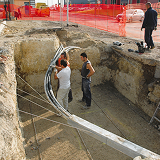
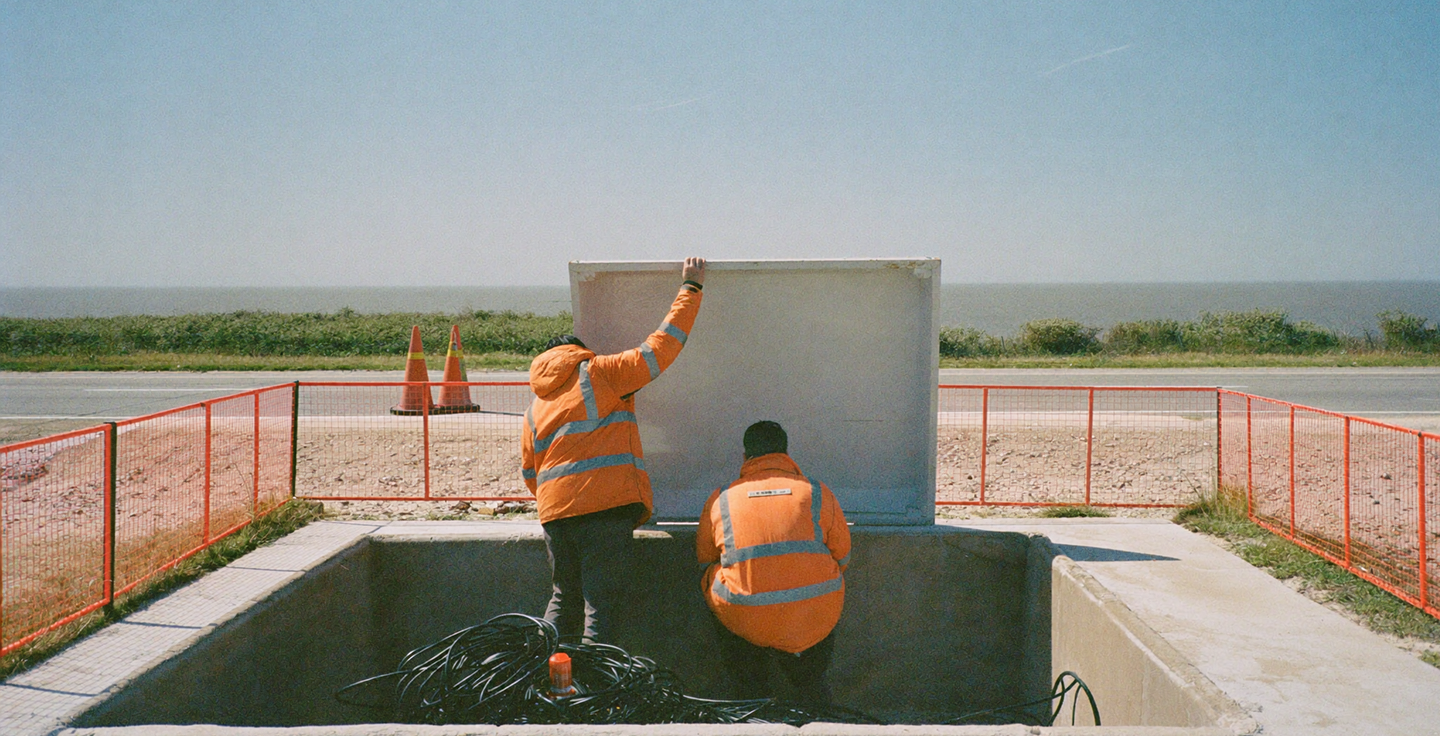
Twenty-five years of the same team, through Hibernia, Interoute, GTT, EXA Infrastructure and Aqua Comms. The engineers who built the first systems still run the network, and they carry what doesn't transfer on paper: where the duct runs, which landing station has headroom, how to get a permit across a border you've never crossed. That knowledge is the part of the advantage you can't buy.
.png)

We build for traffic that doesn’t exist yet.
London, Dublin, Amsterdam, Frankfurt, Paris, Milan and Madrid anchor the network as it stands. We’ve built everything since ahead of the demand, because by the time the traffic arrives it’s too late to start.
Reaching where demand hasn’t arrived yet
East through the Balkans to Turkey and on toward the Caucasus. North into the Nordics, following the power: cold climates and cheap renewables are pulling AI infrastructure toward markets most networks haven’t reached. We’ve committed more than €600 million to it, and most of that has gone on removing bottlenecks rather than adding lanes: new routes into markets that had one way in, old fibre replaced, diversity where there was none.
Built before the demand arrives
Marseille holds as the gateway between Europe, Africa and Asia. We’re extending east toward the Caucasus. By the time traffic catches up to a market, we’re already there. That’s the difference between building for today and building for what’s next.